

Privacy and data flows
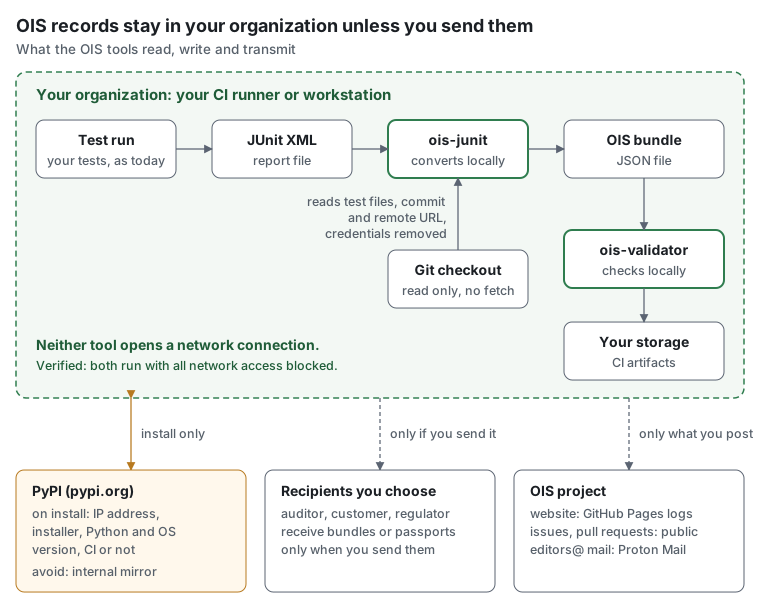
OIS is a data format, and its tools run where you run them. ois-validator, ois-junit and
ois-intent open no network connection: OIS records stay in your organization until you send them somewhere.
Who receives what
Section titled “Who receives what”| Step | What is transmitted | To | How to limit it |
|---|---|---|---|
Installing ois-validator with uvx or pip |
The download request: IP address and, as pip and uv document for PyPI’s download statistics, installer, Python and operating system version and whether it runs in CI | PyPI, run by the Python Software Foundation | Install from an internal package mirror, or a pinned wheel from your own artifact store |
Installing uv with the setup-uv GitHub Action |
The download request | GitHub | A runner image with uv preinstalled |
Running ois-junit |
Nothing. It reads the JUnit XML and the local Git checkout (git rev-parse, ls-files, show, remote get-url; never fetch or push) and writes a file |
Nobody | |
Running ois-validator |
Nothing. The JSON Schema ships inside the package and is never fetched | Nobody | |
Running ois-intent |
Nothing. It reads and writes intent and decision files locally | Nobody | |
| Storing bundles | The bundle file | Wherever your pipeline keeps artifacts | Your retention rules apply |
| Sharing a bundle or passport | Its records (below) | The recipients you choose, such as an auditor or a customer | Review before sharing (specification section 12) |
| Visiting this website | The request: IP address, page, browser | GitHub Pages, which hosts the site | The site loads nothing from other domains and sets no cookies; your theme choice stays in your browser |
| Opening an issue or pull request | What you write | GitHub, publicly | Report security issues privately |
| Writing to editors@openintentschema.io | Your e-mail | Proton Mail, the project’s mail provider |
What a bundle from ois-junit contains
Section titled “What a bundle from ois-junit contains”| Contained | Not contained |
|---|---|
| Test names, as criterion statements | Test output, failure messages and stack traces |
Paths of test files and the sha256 of their content |
The content of test files or any source code |
| Repository URL without credentials, commit hash | User names, e-mail addresses, CI variables or secrets |
| Suite name, the namespace you chose, the pipeline run URL | Host names of build machines |
| Result per test and the time it was observed | Timing or performance data |
Test names and repository URLs can still reveal internal information. Check them before a bundle leaves your organization; test names must not contain personal data (specification section 12.1).
How this was checked
Section titled “How this was checked”ois-validator, ois-junit and ois-intent, and the validator’s whole test suite, were run in a
sandbox that blocks all network access. Both work unchanged; a network request in that sandbox fails. What pip
and uv send to PyPI is taken from their documentation, not measured here.
In the specification
Section titled “In the specification”Section 12 of the specification sets the privacy rules for records: no personal data apart from
actor names and identifiers, pseudonyms for human actors, test data referenced by location and
digest rather than embedded, and datasets with personal data classified as production or
anonymized.